
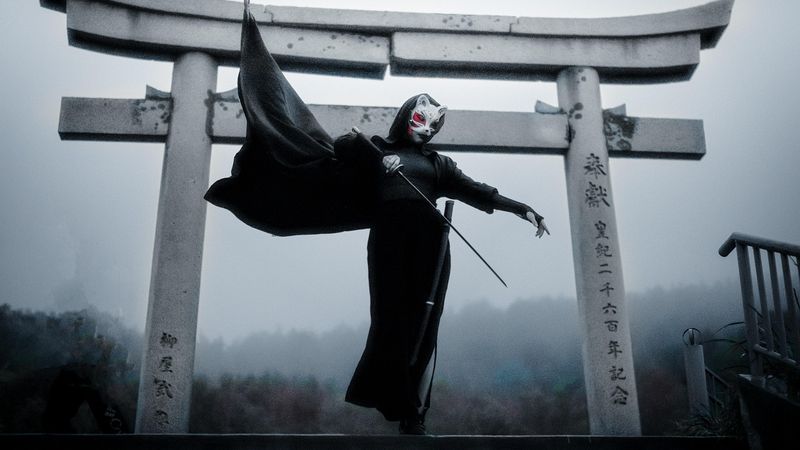
Recently, I re-read one of my favorite books, titled Musashi by Eiji Yoshikawa. I've actually owned this classic novel for a long time, specifically since 2011. Back then, I received the novel from one of my older siblings. They said that the story, which was once serialized in a national print media, was rich with fascinating meanings worth exploring.
Being avid for reading at the time, I naturally accepted it with enthusiasm. It's not surprising, as I've been a book lover since childhood. As a visually impaired person from a small town, it was certainly not easy for me to access reading materials. Therefore, the presence of this novel, published long before I was born, was incredibly meaningful.
Nevertheless, I must admit that I found myself frowning a bit during the reading process. This was because the story, set in 17th-century Japan, presented something new to me at the time, both in its theme, the characters, and the cultural backdrop against which it unfolded. Since childhood, I hadn't been accustomed to reading action stories. Moreover, this is a classic novel, which was naturally rarely mentioned during my childhood in the 90s.
Furthermore, the length of the story also required me to put in more effort to comprehend it. However, little by little, I began to realize that my sibling's words were indeed true. This novel, which tells the life journey of a samurai, is truly captivating. The main character in this story is depicted in great detail, allowing readers like me to follow his character development from a stubborn and narrow-minded youth to eventually becoming a legendary Japanese samurai who understands the meaning of life and possesses mature wisdom, in addition to perfecting his swordsmanship and even creating new sword techniques.
Takezo faced numerous obstacles on his path of the sword, but all of them can be likened to steps that helped him transform into a person worthy of historical recognition. And this journey is portrayed very realistically. Musashi is not depicted as a flawless superhero, but rather as an ordinary human being who often makes mistakes. As depicted of the young Takezo, he often behaved brutally.
In fact, in the part of the story recounting Takezo's past, it is mentioned that he was feared by the people of his village. His father could no longer do much, so Takezo grew into a wild and uncontrollable youth. Furthermore, another part I enjoyed is when Takezo, now bearing the new name Miyamoto Musashi, visits a temple to study martial arts. The temple, located in Nara, was indeed renowned as a center for spear mastery.
There, Musashi dueled with a monk who had mastered the art. Indeed, many had already fallen to the monk. However, in his first move, Musashi managed to kill him. Yet, according to an old farmer who, unexpectedly, had also mastered the art, Musashi's excessive physical strength was actually his weakness. Inevitably, this comment made Musashi uneasy.
He didn't understand the farmer's meaning, and thus it was inevitable that he needed deeper contemplation to understand himself, as well as the meaning of the old farmer's words. But that wasn't the only interesting aspect. Like most others, Takezo, who had transformed into Musashi, was also not immune to connections with the opposite sex. However, the love story presented in this novel was not an ordinary one for me.
There were no romantic scenes, sweet words full of flattery, or other common elements I usually find in other literary works. Nevertheless, the honesty imbued with simplicity between Musashi and Otsu created a sweet impression that made me fall in love with this novel. However, in line with the story's theme, which is Musashi's life journey, this narrative does not focus on romance.
This is certainly different from the literary works I often read, where romance seems to be an obligatory ingredient in every piece. Instead, this story focuses on Takezo's search for self-identity, where he strives to become a true human being through the path of the sword. It is here that he demonstrates his consistency, despite facing various obstacles.
His relationships with other characters in the story also often create distinct conflicts that color Musashi's journey towards his goal. Nevertheless, it is undeniable that these relationships between the characters are what build the story and make it engaging, , where the interactions between them are often unexpected, and thus become something unique.
An example is a Tokugawa samurai named Ayoki Tanziman, who was the leader of the forces hunting Takezo. In the early parts of the story, this character had a dispute with Takuan, a Zen monk who could later be considered Musashi's spiritual teacher. Tanziman's fleeting involvement almost made me forget him, but unexpectedly, his connection to the story reappeared later, when Musashi met a child who begged to become his disciple.
The child who later became Musashi's disciple was Tanziman's son, abandoned at a sake shop by his father who had been ruined by his failure to capture Musashi in the past. This part inevitably made me smile wryly, as one of the series of ironies coloring the story's plot was indeed effective. On one hand, the lives of Jotaro and Ayoki Tanziman were quite distressing, but the author's way of presenting the story and arranging its plot undeniably made it refreshing, preventing this very long tale from becoming tedious to read.
Furthermore, there are many other elements in Musashi's story that I found very interesting. Background descriptions such as natural landscapes, cities, and the exposition of history and culture clearly become a strength that can sweep me away, or more precisely, immerse me in Musashi's journey, which is rich with meaning, just as my sibling said. These descriptions, often presented in poetic language, evoke a serene and calming impression, making them perfect for a refreshing read.
For a visually impaired person like me, these background descriptions made me feel as if I was seeing the natural scenery and other visual objects myself, undeniably refreshing my mind. This impression was not disturbed, despite some scenes imbued with sadistic and harsh characteristics, such as the Battle of Sekigahara, Takezo's killing of the bandit leader, and even Takezo's killing of one of the Tokugawa samurai in his attempt to escape from the Tokugawa samurai besieging the Hon’iden family home.
In this last instance, something else memorable for me was the presence of Osugi, the head of the Hon'iden family. This old woman, the mother of Takezo's friend Matahachi, is an interesting character who harbors a grudge against Takezo for Matahachi's joining the Western army allied with Toyotomi Hideyori. Osugi, offended because she considered Takezo a traitor for not returning with Matahachi from the Battle of Sekigahara, then assisted the Tokugawa forces intending to capture Takezo by feigning friendliness towards the fugitive from the Sekigahara battlefield.
Their plan was for the Tokugawa samurai to surround Takezo while he was bathing. However, Takezo, aware of the encirclement, managed to evade capture. But Osugi's efforts didn't stop there. Fueled by vengeance, she relentlessly pursued Musashi. Otsu, who was originally Matahachi's fiancée, also became a target of this vengeful pursuit. The entire story concerning Osugi, Otsu, and Musashi is truly rich in color.
On one hand, Osugi's cruelty inevitably horrified me, besides making me utterly exasperated. Just imagine, a hunched old woman still trying to hunt down a young man and a girl much younger and, of course, physically stronger than her. This pursuit lasted for years, until Matahachi himself appeared and made his mother swallow the bitter pill of reality about her son not meeting her expectations.
However, on the other hand, I also felt pity for this old woman. Her assumption that Takezo had abducted Matahachi's wife drove her to relentlessly pursue Musashi and Otsu to various places, even leading to the loss of her younger brother, who died during the chase. An ironic endeavor, and one that also ended in an anticlimax. I couldn't help but think that Osugi's character felt extreme.
However, upon reflection, it was understandable, considering the harsh mindset and culture of that era. Nevertheless, for me, it was quite satisfying because the storyline was coherent, making the reasons behind Osugi's actions quite comprehensible. However, not all of this character's attitudes were negative. Her unyielding spirit in defending her family's honor is admirable.
It is these overall interactions that gradually allowed me to understand Japanese culture of that era, along with the diversity of its human characters. Musashi, steadfast in his convictions; Otsu, gentle yet stubborn; Osugi, somewhat terrifying; Takuan, humorous yet firm; and other characters are undeniably excellent references for study. Not only that, Musashi's consistency in pursuing his chosen path is also an important moral value.
A goal often requires considerable struggle and sacrifice. Nevertheless, as a work that presents not always positive interactions among its characters, this novel also features characters who should not be emulated. The character Matahachi, Takezo's friend, is easily influenced, and unknowingly, he caused significant problems between Musashi, Otsu, Osugi, and a mother and child who initially lived on Mount Ibuki.
However, this character also undergoes development, eventually realizing his mistakes and striving to improve himself, though there isn't much he can do. Ultimately, for me, Musashi as a whole is an important novel to read because it offers a broad perspective on humanity and its diverse behaviors. The presentation of Musashi's story in novel form also makes it easier for us as readers to understand Japanese culture of that era, especially concerning Musashi, the legendary swordsman.