
Japanese has become one of the most widely studied languages in the world today. Japan is one of the influential superpowers in the international arena. Its economy is highly advanced, to the point where Western nations, especially America, struggled to cope with trade wars against Japan. Japanese-made electronic and automotive goods dominate the global market.
Furthermore, popular Japanese culture such as music, dramas, comics, and cartoons is highly favored by young generations worldwide. It's no wonder that Japanese is gradually displacing English, which is the number one international language. However, the most challenging aspect of learning Japanese is its writing system. Japanese script is quite complex because it differs from Latin script.
There are three types of scripts used in Japanese: Kanji, Katakana, and Hiragana. Each has its own function. Kanji, which are pictorial characters originating from China, are used to represent words. Hiragana is used to express word endings. Meanwhile, Katakana is used for writing loanwords, country names, and foreign names. Among these three scripts, Kanji is the most difficult to learn.
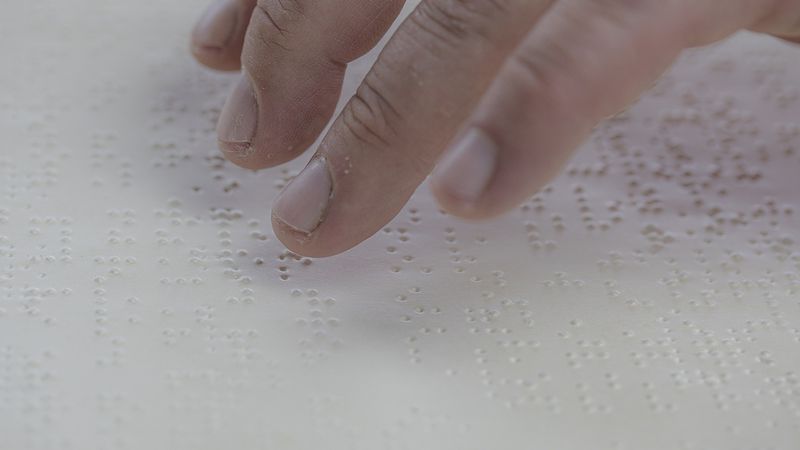
To read books, magazines, and newspapers in Japanese, at least 2,000 Kanji characters must be mastered. That's why a Kanji dictionary is one of the essential dictionaries for Japanese people. So, how do visually impaired individuals read and write in Japanese? Just like in other countries, the visually impaired in Japan also read and write using Braille.
However, the Japanese Braille system differs from the general Braille system. While visually impaired individuals generally learn Braille based on the Latin alphabet from A to Z, visually impaired Japanese individuals learn Braille based on syllables, for example, A I U E O, Ba bi bu be bo, Ka ki ku ke ko, and so on. In Japanese, Braille is called Tenji, which means 'raised dots'.
To write one syllable in Japanese Braille, two Braille cells are required. In the Japanese Braille system, there are no capital letter signs, commas, separators, or contractions. Reading Japanese Braille is almost like reading musical notation. Of the three commonly used Japanese scripts, only Hiragana and Katakana have Braille symbols. Tenji is a combination of Katakana and Hiragana.
Kanji, on the other hand, does not have Braille symbols. Braille symbols cannot be used for Kanji characters because Kanji are pictorial characters and are numerous. Japanese Braille book producers typically first transliterate all material written in Kanji into Katakana and Hiragana. Only then is the material transliterated into Braille. However, with technological advancements and extensive volunteer assistance for Braille book producers, Japan faces no difficulty in creating the books needed by the visually impaired.
Evidently, Japan has thousands of Braille book titles that can be read quickly by the visually impaired. Braille libraries are also widely distributed in Japan, one of which is the Japan National Braille Library. Braille books can also be enjoyed in public libraries. Unfortunately, information about the Japanese Braille system is still not widely known by visually impaired individuals outside Japan, especially those in Indonesia.
Yet, the interest of visually impaired Indonesians in learning Japanese is very high. The lack of information about the Japanese Braille system makes visually impaired individuals hesitant to learn Japanese. Decades ago, the Indonesian Braille Publishing House (BPBI) Abiyoso received many Braille book shipments from abroad, including from Japan. Because no one could read them, those Japanese Braille books eventually deteriorated, simply eaten by termites.
Given the considerable interest of the visually impaired in Japanese, it is time for visually impaired educational institutions and Braille book producers in Indonesia to seek information about Braille systems in various countries, especially those with different Braille systems, such as Japan. This way, more foreign languages can be mastered by visually impaired individuals in Indonesia.